The Quiet Room: How to Carve Out a Snug That Earns Its Square Metres

Photo: Fanny (Appleton) Longfellow (1817-1861), Public domain, via Wikimedia Commons
Somewhere over the past decade the small room quietly disappeared from the British house. Walls came down, rear extensions opened up, and the kitchen, dining room and sitting room merged into one generous volume with an island at its centre. It was a reasonable idea, and for many households it still is. But a room that does everything can struggle to do any one thing well, and the room most often lost in the process is the one where nothing in particular was supposed to happen.
That room is coming back. Not as a period pastiche with a dado rail and a drinks trolley, but as a genuinely useful piece of planning: somewhere small, warm, quiet and deliberately unambitious.
Why we are drawn back to smaller rooms
A snug works because it is bounded. Four walls hold heat and sound in a way that an open plan never will, and a door that closes is now a luxury in its own right. Households with two people working from home, with teenagers, with a television that everyone wants to watch and nobody wants to hear, have discovered that an extra eleven square metres in one room is worth less than three square metres behind a door.
There is an energy argument too. Heating a whole ground floor in order to sit in one corner of it is difficult to justify, whether the boiler is new or not. The snug is the room you can heat, light and occupy without any sense of waste.
Finding the room you already own
Most houses have a candidate. The box room of roughly 2.4 by 2.7 metres is the classic, and it is a perfectly workable snug if the furniture respects it. Less obvious options include the cold end of a rear extension that nobody sits in, the inner half of a through-lounge that can be closed off with a partition and a pair of glazed doors, the rear bay of an integral garage, or the dining room that is used twice a year and furnished for twelve.
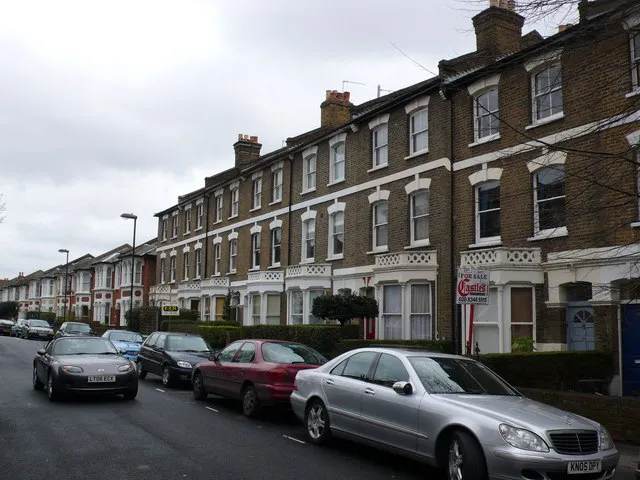
Where the house is listed, or sits in a conservation area, the structural moves need consent and a conversation with the local authority before anything is drawn. In an ordinary Victorian or Edwardian terrace, an internal partition rarely needs consent but will need to satisfy building regulations for fire and escape routes where it affects a hallway or stair.
Proportions, and furniture that behaves
Small rooms are ruined more often by scale than by size. A sofa of 1.6 to 1.8 metres is usually the right length for a snug; anything deeper than about 900 millimetres will dominate the floor and make the room feel like a corridor. Two comfortable armchairs and a small sofa is a better arrangement than one large corner unit, and leaving 750 millimetres of clear circulation between furniture and wall keeps the room from becoming an obstacle course.
Resist the coffee table. In a room this size a pair of small side tables, or a narrow bench along one wall, does the same job without colonising the centre. Keep shelving low, or take it to the ceiling and paint it in the wall colour so that it reads as architecture rather than furniture. A single rug, large enough to sit under the front legs of everything, will bind the arrangement together.
Light in three layers
A snug needs light that is warm, low and reachable. The first layer is a ceiling fitting on a dimmer, used sparingly and rarely at full output. The second is wall lighting: sconces or picture lights set at roughly 1.5 to 1.7 metres, at the height of a seated eye, so that light falls on a page or a face rather than into it. The third is a floor or table lamp beside every seat, close enough to switch off without standing up.
Avoid a grid of downlights in a small ceiling; they flatten the room and put glare exactly where nobody wants it. Choose 2700K lamps throughout, check that the dimmer is compatible with the LED driver, and put the circuits on separate switches so the room can be lit at three different intensities depending on the hour.
Heating a room you sit still in
Sitting still is colder than moving about, and a snug is a room for sitting still. Radiator output should be matched to the volume of the room rather than inherited from the one that was there before, and a thermostatic valve on the radiator will let the room be warm without overheating the rest of the house. Thermal curtains, a well-fitted door and a draught excluder do more than most people expect.
Where a wood-burning stove is being considered, the practical questions come first: whether the property is in a smoke control area, whether the appliance is Ecodesign compliant, what the flue route and the air supply will be, and whether building regulations notification and a carbon monoxide alarm are in place. A small room is easily overpowered by a stove rated for a much larger space, so the nominal output should be chosen with care rather than by habit.
Storage that disappears
A restful room needs somewhere for the mess to go. Alcove cupboards built to the depth of the chimney breast, a bench with a lift-up seat, a closed cupboard for blankets, controllers and the paperwork that accumulates wherever people sit: these are the interventions that keep a small room from becoming a storage problem with a sofa in it.
Open shelving is charming in photographs and demanding in life. If it is used at all, keep it to one run, high up, and accept that it will need editing.
The test of a good snug
A snug is working when two people can sit and read without negotiating over the furniture, when a lamp can be reached without leaving a chair, when the door closes and the sound of the rest of the house recedes, and when there is somewhere to put down a cup. None of that requires a large budget. It requires a smaller plan, drawn honestly, and the discipline to resist filling the room simply because it is there.