Soft Light, Warm Surfaces: Designing a North-Facing Kitchen That Feels Inviting
North-facing kitchens have a reputation problem. In a British terrace or semi-detached house, the room that looks out over a shaded side return or a garden that catches sun mainly in the afternoon can feel cool in both senses: physically chilly and emotionally reserved. Yet the assumption that such a kitchen must be painted white and flooded with electric light is too crude. A north-facing room receives soft, diffused daylight that is unusually kind to timber, stone and skin tones. The task is not to force it to behave like a south-facing room, but to give that gentle light something warm and generous to land on.
Read the light before choosing a scheme
North light is consistent rather than dramatic. It lacks the strong shadows and moving pools of sunlight that can make a south-facing room feel lively, but it also avoids the glare that can wash out a scheme. In the UK, that softness is particularly welcome in autumn and winter, when daylight hours are short and the sky is often overcast. The difficulty is not usually brightness; it is a lack of contrast and direction.
Spend a week observing the room at different times: early morning, midday, late afternoon and after dark. Note where the light falls, which surfaces it catches and where shadows gather. A kitchen with a single window over the sink and a door to the garden will behave differently from one with a side window and a borrowed light from a hallway. These observations should inform the lighting plan and the palette, rather than being left until the decoration stage.
Layout moves that make the room feel generous
A north-facing kitchen often feels smaller than it is because the eye has nowhere to travel. Keep sightlines as clear as possible. Avoid placing a wall of tall units directly in front of the main window, and consider whether a low run of base units with a light-coloured wall above will feel more open than a full bank of cabinetry. In narrow terraces, a peninsula can be more useful than a forced island, giving a sense of division without blocking the view.
Use the internal walls for storage and leave the window wall comparatively quiet. A deeper colour on the base units can ground the room, while a lighter tone above keeps the upper plane calm. If the ceiling is low, paint it in a soft off-white rather than a brilliant white; the slightly warmer tone will reduce the contrast between wall and ceiling and make the room feel less top-heavy.
Warm neutrals and a considered palette
An all-white scheme is not the answer to a dark room. White can look grey in north light, and too many cool whites can make a kitchen feel clinical. Instead, choose warm neutrals with a little pigment in them: mushroom, putty, soft clay, pale stone, bone and muted ochre. Test samples on A2 boards in the actual room, viewing them at different times of day and against the proposed worktop and flooring. A colour that looks warm in a south-facing showroom can turn distinctly grey in a north-facing terrace.
Avoid greys with strong blue undertones unless they are part of a deliberate cooler scheme. If you want contrast, introduce it in the joinery, a tiled splashback or a painted ceiling rather than in the main wall colour. A warmer neutral envelope gives the room a quiet warmth that does not depend on direct sunlight.
Timber, stone and surfaces with warmth
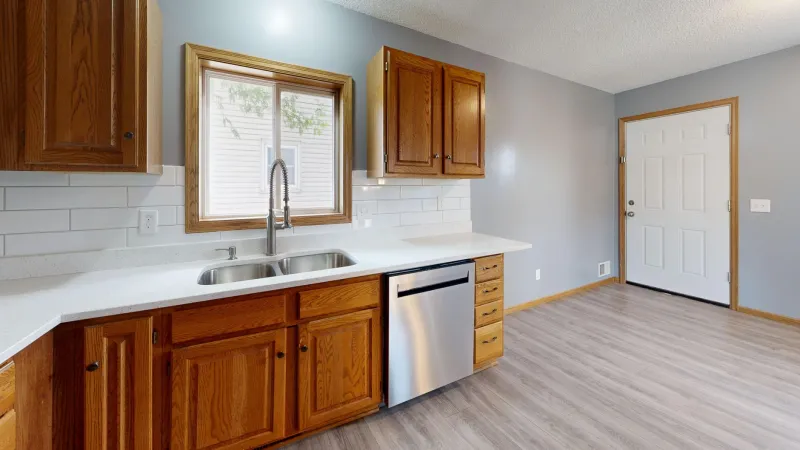
Natural materials are particularly effective in north light. Oak, ash and elm bring a soft grain and a warmth that painted surfaces cannot replicate. A timber floor, a solid timber worktop or open shelving in a warm-toned wood can make the room feel more grounded. Stone is equally useful: honed limestone, soapstone and warm-toned quartz all offer subtle variation without the cold sheen of polished surfaces.
Be cautious with large-format tiles in cool greys or high-gloss finishes. A splashback in a warm-toned glazed tile, brushed metal or antique mirror can bounce light without creating glare. Unlacquered brass and aged metals will patina over time and add a layer of warmth that suits older houses particularly well. These choices are not merely decorative; they change how the room feels in low light.
A lighting plan in layers
No north-facing kitchen should rely on recessed downlights alone. A layered plan should include ambient light for the room as a whole, task light for worktops and cooking, and accent light for shelves, artwork or a dining table. Warm white bulbs of 2700K to 3000K with a high colour-rendering index will make food, timber and painted surfaces look their best. Dimmers on the main circuits allow the room to shift from practical daytime use to a softer evening mood.
Under-cabinet lighting is especially valuable in a north-facing kitchen, because it puts light exactly where it is needed without lighting the whole room harshly. Pendants over an island or dining table add a focal point, while wall lights or a floor lamp can warm a corner that would otherwise feel forgotten. If the ceiling is being replastered or the electrics are being upgraded, plan these circuits now; retrofitting them later is far more disruptive.
Reflective surfaces without mirrors
Reflection is useful, but it should be used with restraint. A glazed splashback, a satin-finish worktop or a brushed metal tap can catch and redistribute light. An antique mirror splashback can look elegant in a period kitchen, provided it is properly sealed and positioned away from direct heat and water. Avoid a collection of highly polished surfaces that create glare; the aim is to soften and bounce light, not to multiply it.
The pre-renovation checklist
Before committing to a new kitchen, establish what is actually causing the gloom.
- Observe the room at 8am, midday, 4pm and after dark for at least a week. Note where daylight falls and where artificial light is needed.
- Decide whether the problem is daylight, layout or lighting. If daylight is adequate but the room feels flat, a new lighting plan and decoration may be enough.
- Before replacing windows, check whether the property is listed or in a conservation area. Improved glazing can help, but it will not transform a dark plan on its own.
- If the cabinets are sound, consider painting or refacing them rather than replacing them. Put the budget into lighting, worktops and flooring instead.
- Plan the electrical layout first: circuits, dimmers, under-cabinet lighting, island pendants and wall lights. It is far cheaper to do this before plastering.
- Test paint colours in situ on large boards, and view them against the proposed stone and timber samples.
- Choose the worktop and splashback together. A warm stone and a subtle sheen can do more for a north-facing room than an extra row of downlights.
- Keep a contingency in the budget. Lighting and finish decisions often evolve once the room is stripped back.
A north-facing kitchen does not need to be brightened into submission. With a warm-neutral palette, tactile materials and a properly layered lighting plan, it can become one of the most restful rooms in the house: cool in the best sense, and generous in the way it accommodates daily life.