The Plane Above: A Practical Brief for Period Ceilings
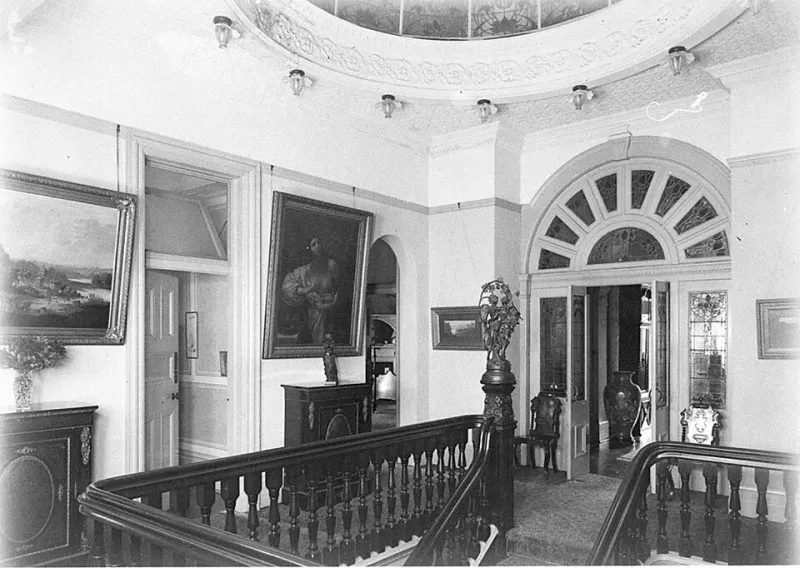
Photo: Sam Hood, Public domain, via Wikimedia Commons
In many period homes, the ceiling is treated as a background: something to be patched, painted white and forgotten until a crack becomes impossible to ignore. Walls receive colour, floors receive timber or stone, kitchens receive the lion's share of the budget. The plane overhead, meanwhile, is left to sag quietly or disappear beneath yet another coat of contract emulsion. This is a missed opportunity. In a period house, the ceiling is not merely the underside of the roof or the floor above; it is one of the principal makers of proportion, light and architectural character.
Read the ceiling before decorating
Before choosing a paint colour or booking a plasterer, establish what the ceiling is doing and why. In older properties, many ceilings are of lath and plaster rather than plasterboard. Hairline cracks along the line of the laths are common and often stable. Broader cracks, a hollow sound when tapped, or a visible belly in the surface may point to failed keys or water ingress, and these should be investigated rather than filled and forgotten. Staining is not merely cosmetic: it usually has a source, whether a slipped slate, a blocked gutter or a historic leak that has since been repaired.
Height matters as much as condition. A Georgian or Victorian room may rely on a deep cornice and a generous ceiling height to achieve its sense of ease. An Edwardian terrace may have a simpler run of moulding and a more modest rose. Removing either because it is damaged, or because a previous owner disliked it, alters the room's proportions more than many homeowners expect. The cornice visually lowers the ceiling at the edges and softens the junction between wall and overhead plane; without it, a tall room can feel abrupt and a small room can feel unfinished.
Cornice and centre rose: repair or replace
Original plasterwork is usually worth saving where it remains sound. Repair is often more economical than replacement, particularly when only a section has failed. A skilled plasterer can cast a matching profile from an existing run, splice in new work and blend the junction so that the repair is not obvious once painted. The same applies to centre roses: if the bulk of the ornament is intact, careful consolidation is preferable to swapping it for a lightweight modern copy that lacks the same depth of relief.
Replacement becomes the more sensible route when the original has been removed altogether, when large sections are beyond saving, or when a modern ceiling has been installed at a lower height and the old details no longer sit correctly. In listed buildings, consent may be required before altering or removing historic plasterwork, and it is always wise to take advice before work begins. Even in unlisted period homes, matching an existing profile is preferable to introducing a generic catalogue pattern that bears little relation to the house.
There is also the question of what the ceiling is asked to carry. A heavy original rose may not suit a modern pendant position, and a large light fitting can obscure the detail it is meant to complement. Establishing the lighting layout before plastering is repaired or replaced avoids later damage and unnecessary making good.
The geometry of height and colour
A common assumption is that every ceiling should be white. In practice, the right finish depends on the room's height, light and orientation. In a low or north-facing room, a very bright white can feel cold and clinical, particularly under grey daylight. A softer off-white, a pale stone or a delicate tint drawn from the walls can make the ceiling feel less like a lid and more like part of the room. In a tall room, a stronger colour overhead can be effective, drawing the eye upward and giving the ceiling a deliberate presence rather than leaving it as an afterthought.
Sheen is a practical consideration as well as an aesthetic one. Standard matt emulsion is forgiving on imperfect plaster, but it marks easily in busy areas. A low-sheen or washable finish may be more suitable for hallways and family rooms. Traditional limewash can be beautiful on older plaster, but it requires an appropriate substrate and a willingness to accept a softly variegated finish. Whatever the product, the preparation matters more than the tin: filling, sanding and priming should be carried out with the same care as on any wall.
Lighting the upper plane
Lighting has a disproportionate effect on how a ceiling is read. A single pendant in the centre of a room may be historically appropriate, but it is not always the most flattering arrangement for daily life. Surface-mounted fittings, wall uplights and discreet picture lights can wash the ceiling and reveal its texture without cluttering the plane with downlights. Where recessed lighting is unavoidable, fewer and better-placed fittings will usually serve the architecture better than a grid of small circles.
In rooms with original cornice, avoid placing fittings so close to the edge that they graze the moulding awkwardly. In rooms with a centre rose, consider whether the pendant should hang from the rose itself or be offset to suit a table, a seating arrangement or a circulation route. The ceiling may be the fifth plane, but it should not be designed in isolation from the life below it.
Sequencing the work
Ceiling work is messy, and it is best done before decoration, flooring and fitted furniture. If scaffolding or a tower is required, the room should be cleared properly rather than worked around. Cracks should be diagnosed before filling, cornice repaired before painting, and lighting cables run before plaster is made good. This sequencing is unglamorous, but it is the difference between a ceiling that looks cared for and one that has simply been covered up.
A period ceiling deserves more than a hurried coat of white. It deserves to be inspected, understood and repaired where necessary, then finished and lit in a way that acknowledges its role in the room. Done well, the work is seldom noticed as a feature in its own right. It simply makes the space feel more generous, more settled and more complete.